
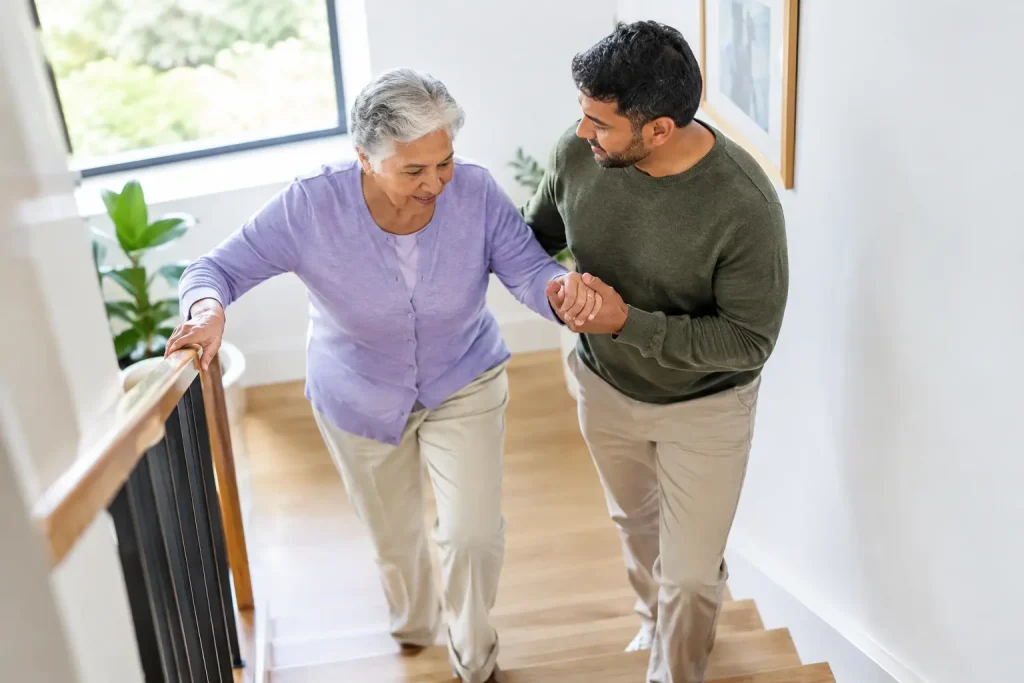
The bedroom may be upstairs, the bathroom on a half-landing and the kitchen downstairs. When movement becomes harder, an ordinary staircase can begin to determine which parts of home a person feels able to use.
Helping an elderly person get up and down stairs is not simply a matter of standing close enough to catch them. The person’s abilities, the staircase and the assistance available all need consideration. Poorly planned handling can injure both the person receiving help and the relative providing it.
This guide is for families in England concerned about a relative’s stair use. It explains what to check, what to ask a professional and when adaptations may be more appropriate than additional hands-on help. It is not a substitute for an individual stair assessment.
Start by Understanding What Has Become Difficult
Ask about the particular part of the journey that causes difficulty. Is it lifting a foot onto a step, coming downstairs, turning on the landing or reaching the bathroom afterwards?
Describe what happens rather than asking the person to demonstrate something they already find unsafe.
Useful observations might include:
- Whether the difficulty occurs going up, coming down or both.
- Whether it changes with tiredness, pain or the time of day.
- Whether the person has stopped using a room because reaching it feels difficult.
- Whether they now need physical assistance rather than reassurance alone.
Tell the GP, physiotherapist or occupational therapist what has changed. A review may consider balance, strength, vision, medicines and the home environment. These are among the areas considered by NHS falls services.
Someone managing well on level ground does not establish that their staircase is suitable. Ask for advice that accounts for the steps, turns, handrails and landings in the actual property.
Before Helping, Make the Staircase Easier to Use
Begin with the surroundings rather than a new way of holding the person.
Check the entire route, including the approach to the stairs and the space at the top. HSE’s stair-safety guidance highlights lighting, suitable handrails, slip resistance and the removal of obstacles.
| What to check | What needs attention |
|---|---|
| Steps and landings | Remove shoes, bags, trailing cables and other obstacles. Arrange repairs to loose or damaged surfaces. |
| Lighting | Make sure the person can see the steps and landings clearly, including during darker mornings and evenings. |
| Handrails | Check that rails are secure and usable. Ask whether an additional rail would help. |
| Footwear | Use well-fitting, supportive footwear that does not easily slip off. |
NHS falls-prevention guidance also recommends keeping stairs clear, using suitable footwear and switching on lights when the route is not adequately lit. These changes support safer surroundings, but do not resolve every mobility difficulty.
Arrange for laundry, drinks and other items to be moved separately rather than adding carrying tasks to an already difficult journey. Ask the therapist how to manage essentials without interfering with the assessed use of the rail or walking aid.
Get the Assistance Assessed Before Taking Someone’s Weight
There is an important difference between accompanying someone who can manage the stairs and physically supporting someone who cannot.
Do not assume that being stronger than your relative makes you able to support their weight safely on a staircase. Ask a professional to assess whether assistance is appropriate and demonstrate the method to anyone expected to provide it.
The NHS advises training or a healthcare professional’s demonstration when regularly helping someone move. It also recommends seeking occupational therapy advice about moving-and-handling needs.
Ask the assessor to explain where the helper should stand, what assistance is permitted, which equipment is needed and what to do if the person cannot continue. These details depend on the individual and the task; a generic “stand behind them” instruction is not enough.
If the plan requires more assistance or different equipment than is available, do not substitute an improvised hold. HSE recommends recording the necessary technique, equipment and number of helpers, and reviewing the plan when circumstances change.
Our guide to arranging mobility assistance at home considers the wider support around everyday movement.
What About “Stronger Leg First” on the Stairs?
You may have heard the reminder to lead with the stronger leg going upstairs and the affected leg coming down. This describes a method used in some rehabilitation guidance—it is not a universal assessment of whether someone should attempt stairs.
For example, University Hospitals Sussex gives the following sequence for patients allowed unrestricted weight bearing, using a handrail and an appropriate stick or crutch:
| Direction | Sequence described in that guidance |
|---|---|
| Going upstairs | Stronger leg first, then the affected leg, followed by the walking aid onto the same step. |
| Going downstairs | Walking aid first, then the affected leg, followed by the stronger leg onto the same step. |
This is an example of a technique a therapist may teach, not an instruction to begin practising without assessment. Someone who has been told not to put weight through a leg, or has different restrictions, needs their own guidance. Ask the therapist to demonstrate the complete journey, including the landings and any assistance required.
Walking Sticks and Frames Need Separate Consideration
A stick used on level ground is not automatically being used appropriately on stairs. The NHS recommends physiotherapy advice where a walking stick is needed for steps. Check that the aid and the technique are suitable for the person.
Do not use a standard walking frame to climb a flight of stairs. NHS guidance specifically warns against taking a frame upstairs. If a frame is needed on both floors, ask the therapist about appropriate equipment at each level rather than carrying it during the stair journey.
Equipment should support an assessed plan. It should not become an experiment undertaken because the person is already halfway through a difficult journey.
When Hands-On Help Is No Longer Enough
Consider asking for a reassessment when the person catches their feet on steps, loses confidence in the rail, repeatedly needs more assistance than planned or avoids essential rooms.
Explain the effect on everyday life. For example:
“Mum can reach the bedroom in the morning, but by evening she is too tired to manage the stairs as she was shown.”
Or:
“Dad is avoiding the upstairs bathroom because he is frightened of coming down afterwards.”
These examples describe the problem more clearly than saying that someone “needs watching”.
Changes in ability, fatigue or the assistance required should prompt a review of the handling plan. The answer may be a different approach or adaptation—not simply asking the same helper to take more weight.
After a Fall or Sudden Change
Call 999 if the person has fallen and cannot get up, or may have injured their head, back, neck or hip. Keep them warm and comfortable while following the call handler’s advice. Do not try to lift them yourself.
For a fall involving possible pain, injury or illness without those emergency features, NHS 111 can advise. A GP review is also appropriate after a fall or when balance and mobility are causing concern.
Sudden confusion or suspected stroke symptoms—including facial drooping, arm weakness or speech difficulty—also require an immediate 999 call. Do not treat these as a reason merely to arrange more stair assistance.
Severe breathing difficulty, or a chest that feels tight or heavy, also needs emergency help.
Consider Adaptations Before Every Journey Becomes a Struggle
A home assessment can consider whether changes would make everyday movement more manageable. In England, the local council offers a free assessment for equipment and adaptations, with an occupational therapist considering the difficulties in the home. Recommendations may include additional rails, a stairlift or other changes.
Discuss the person’s goals, not only the staircase. Which rooms do they want to keep using? Where do they wash, sleep and spend time with their partner?
A Stairlift Needs Its Own Assessment
Ask whether the person could get onto and off the seat safely, use the controls and manage at both landings. What assistance would still be required?
Seek professional advice before purchasing moving or access equipment. A solution should fit the individual’s abilities and the property, rather than being chosen solely because it removes the need to climb steps.
A Downstairs Arrangement May Be an Option
Sometimes a temporary bedroom downstairs can reduce the immediate need to use stairs during recovery. NHS rehabilitation guidance identifies this as something to discuss with the therapy team when stair use is not yet manageable.
Think through toileting, washing, privacy and access as well as where the bed will go. Ask whether any additional equipment or assistance is needed.
Our guide to home adaptations for reduced mobility explores changes beyond the staircase itself.
Preserve Dignity While Changing the Arrangement
Ask what the person finds most frustrating or worrying. They may be concerned about losing access to their bedroom, disturbing a partner or becoming dependent on relatives.
Explain the purpose of an assessment without presenting the outcome as already decided:
“I want us to find a way for you to use the rooms that matter to you without either of us having to guess how to help.”
Ask permission before offering assistance and use the communication approach agreed with the person and the assessor. Avoid several people giving competing instructions.
A risk assessment should consider the person’s wishes and abilities alongside safety, rather than imposing unnecessary restrictions. HSE’s guidance specifically recognises the importance of autonomy and dignity when deciding how mobility risks are managed.
Plan Support Around Access to the Whole Home
Look beyond whether one stair journey is possible. What happens when the person needs the bathroom at night, is more tired than usual or cannot manage the route they normally use?
Agree who will provide any necessary assistance and what the alternative is when the assessed method is no longer workable. A care arrangement should not depend on a relative improvising each time circumstances change.
Live In Care Ltd is a family-owned, CQC-regulated provider of fully managed live-in care across England. Our assessment considers the person’s needs and preferences and whether suitable support can be provided.
A carer’s presence should not be treated as permission to continue an unsuitable stair arrangement. Explain the professional guidance already given, any equipment required and the difficulties that remain.
The aim is not to preserve stair use at any cost. It is to preserve access to the parts of home and daily life that matter, through an arrangement that works for the person and those assisting them. Our ageing-in-place guide considers that wider picture.