
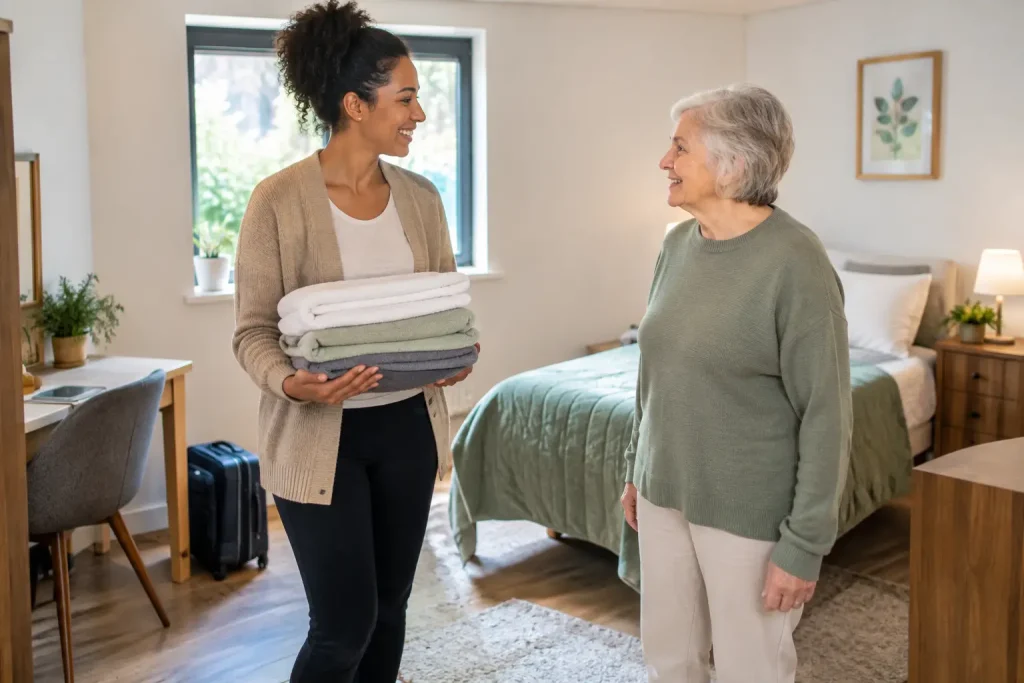
Yes. For live-in care with Live In Care Ltd, the carer needs a bedroom of their own. A shared bedroom or a sofa in a communal sitting room is not a substitute for private accommodation. Our published requirements allow either a single or double bed, together with bedding, clothing storage and access to a bathroom.
That does not mean creating a luxury guest suite. The aim is to provide somewhere comfortable to sleep, keep belongings and spend private time during the placement.
Before buying furniture or rearranging the house, discuss the proposed room with the care team. Its suitability depends on how it works within the home and the care arrangement—not simply whether a bed fits.
Why a Private Bedroom Matters
A live-in carer shares the household for the agreed placement, but that does not mean being continuously available. Breaks, sleep and personal time need to be part of the arrangement.
A separate room makes those boundaries easier to respect. The carer can change clothes, make a private telephone call or rest without occupying the family’s main living space. The person receiving care can also continue using their sitting room without worrying about disturbing someone sleeping there.
Think of the room as accommodation for the duration of the placement, not somewhere temporarily cleared each evening. It should remain available when the carer needs to rest, rather than becoming a family workspace or visitors’ room during the day.
What Should the Carer’s Bedroom Include?
Start with the practical essentials. Live In Care Ltd asks households to provide a bed, two sets of bed linen, clothing storage and bathroom access. A television or bedroom chair can be a welcome addition, but neither is compulsory. Wi-Fi is also requested for electronic care records and communication. Our guide to arranging live-in care sets out these requirements.
Use this checklist when preparing the space:
| Feature | What to check |
|---|---|
| Bed and bedding | A proper single or double bed, a comfortable mattress and clean bedding, with a spare set available. |
| Clothing storage | Usable hanging space and drawers—not cupboards still full of household belongings. |
| Privacy | A door that closes and suitable curtains or blinds where needed. |
| Comfort | Working heating, adequate ventilation and lighting suitable for everyday use. |
| Usable space | Enough clear space to move around and store belongings without blocking the doorway. |
| Everyday facilities | Bathroom access, accessible sockets and the agreed internet connection. |
The room should be clean, comfortable and genuinely available for the carer’s use. Our broader guide to preparing your home for live-in care covers the household arrangements alongside accommodation.
Does a Live-In Carer Need an En-Suite Bathroom?
No. A separate bathroom can be helpful, but it is not always necessary. A shared bathroom can work where access is practical and everyone’s privacy is respected.
Discuss how the household normally uses the facilities. Is there time for the carer to get ready? Where can they keep toiletries? Would reaching the bathroom involve walking through somebody else’s bedroom?
These are useful questions to resolve beforehand. The aim is a workable arrangement, not a requirement to install another bathroom.
Can a Study or Dining Room Become the Carer’s Bedroom?
A room’s current name matters less than whether it can provide suitable sleeping accommodation. However, converting its use should be discussed and agreed before care begins.
A Study or Home Office
A study may be worth considering if it can become a private bedroom with a proper bed and appropriate facilities.
Move frequently used paperwork, printers and other shared items elsewhere. A room does not provide dependable privacy if relatives regularly need to enter it to work or retrieve documents.
For example, clearing a desk to make space for a bed does not solve the problem if someone still needs that desk every morning. Explain the intended use honestly so the care team can consider whether the arrangement is workable.
A Dining Room
A separate dining room may be another possibility, but consider what the household would lose and how access would work.
Would everyone need to pass through it to reach the kitchen or garden? Could meals comfortably take place elsewhere? Can the room be closed off without blocking an essential route?
Do not assume that a curtain across an open-plan space provides the same privacy as a separate room.
A Conservatory, Loft or Outbuilding
These spaces need particular consideration before being offered as bedrooms. Ask about temperature, ventilation, privacy, access, noise and whether the space is suitable for regular sleeping.
A provider’s care assessment is not a substitute for any building or conversion advice the property requires. Do not begin alterations or purchase equipment on the assumption that the proposed room will be accepted.
Safe care requires the relevant risks and practical arrangements to be assessed. CQC’s safe care and treatment guidance places responsibility on providers to identify and address risks rather than rely on an improvised arrangement.
Is a Sofa Bed Acceptable?
A sofa bed in a lounge that remains a shared living room does not provide the private bedroom required for our live-in service.
Putting it away each morning does not address interruptions, storage or the carer’s access to private space during breaks.
If you are considering a particular fold-out bed in a separate room, ask the care team before relying on it. Describe the bed and how the room will be used throughout the placement. Do not assume that any item advertised as a bed will be suitable for regular sleeping.
Similarly, sharing with the person receiving care, another household member or visiting relatives is not an alternative to providing the carer’s own room.
Does the Bedroom Need to Be Next Door?
The most appropriate room depends on the home’s layout and the person’s assessed care needs. Being nearby is not, by itself, a complete plan for obtaining help.
Where occasional night-time assistance is included, agree how the person will summon the carer and check that the alert can be received from the proposed bedroom. Consider closed doors, distance and whether the person can reliably use the agreed method.
If they cannot call for help, the provider needs to assess what arrangement is appropriate. Do not assume a sleeping carer will hear every movement or that leaving bedroom doors open resolves the risk. Our overnight care preparation guide explains these checks.
Frequent or prolonged night-time assistance may require additional support. Moving the carer into a closer room does not remove their need for sleep or make an unsuitable sleeping-night arrangement sufficient.
Check Fire Safety and Access
Think about the route out of the proposed bedroom, not only the route to the person receiving care.
Keep escape routes clear, make sure relevant keys are accessible and explain the household’s emergency arrangements. Consider what assistance anyone in the home would need to leave safely.
Devon and Somerset Fire and Rescue Service’s escape-planning guidance recommends planning around everyone in the household, including anyone who may need help. Flats and other buildings may have specific arrangements that must also be understood.
Do not block a doorway with furniture or treat a room with unsuitable access as acceptable simply because it is otherwise comfortable.
What Happens When Relatives Visit or Carers Change?
During the placement, the carer’s bedroom should not be reclaimed for guests. Arrange visiting relatives’ accommodation separately rather than asking the carer to move onto a sofa.
Agree that household members will respect the room’s privacy. Move shared items out beforehand, and discuss access for cleaning, maintenance or another necessary reason instead of assuming anyone can enter whenever they wish.
Different carers may use the same bedroom at different times as placements change. Plan for fresh bedding and a clean room between arrivals. If a handover involves an overnight overlap, discuss sleeping arrangements in advance rather than assume two carers will share.
Raise any proposed change of room with the care team before it happens. A room previously accepted for the arrangement does not establish that a different space will be equally suitable.
What If There Is No Spare Bedroom?
First, explore whether an existing room can become suitable without undermining the person’s own access, comfort or daily life.
If that is not possible, a different care arrangement may be needed. Options can include visiting support during the day or separately arranged night care, depending on the assistance required. The NHS guide to care at home describes support provided through visits, including at night.
The accommodation distinction remains important:
Live-in respite care still needs a suitable bedroom. A shorter placement does not remove the need for private accommodation.
Sleeping-night care still needs sleeping accommodation. Our overnight service requires a bed where the carer is expected to sleep between occasional calls.
A separate waking-night arrangement is different. A carer attending to remain awake during an agreed night period does not need a bed for sleeping during that period, but suitable facilities and an appropriate place to be based must still be agreed. This is not a substitute for daytime support or a way to make one live-in carer work without rest.
Choose the support around the person’s needs, not simply around whichever arrangement avoids using a bedroom.
Discuss the Room Before Confirming Care
Live In Care Ltd is a family-owned, CQC-regulated provider of fully managed live-in care across England. Our assessment considers the home environment and accommodation alongside the support required.
When you contact our care team, describe the room you have available and any questions about its use. Mention shared access, bathroom arrangements, overnight needs and whether relatives normally use the space.
You do not need expensive furnishings before making an enquiry. You do need a realistic plan for a comfortable private bedroom that remains available throughout the placement.
The right starting point is not “Can we fit a bed in?” It is “Can this room provide suitable rest and privacy while the agreed care works safely for everyone?”