
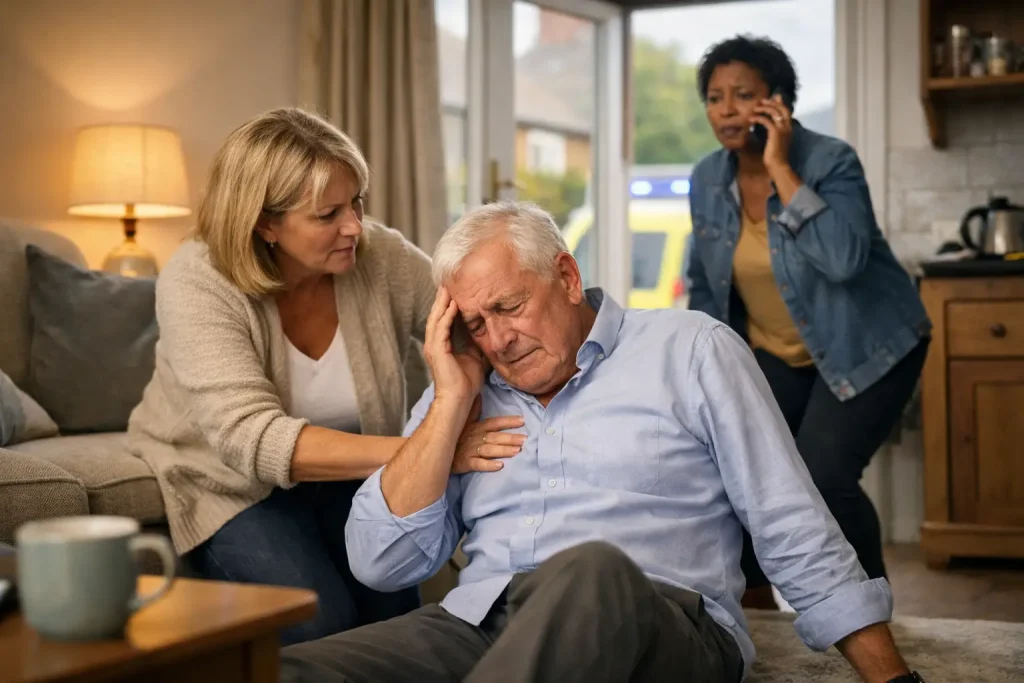
A cup falling from a hand, words that suddenly do not make sense, or a smile that looks uneven can be easy to dismiss in the moment. Yet stroke symptoms often begin without pain or warning, and every minute matters. If you think someone may be having a stroke, call 999 straight away – do not wait to see whether they improve.
A stroke happens when the blood supply to part of the brain is interrupted, either by a clot or bleeding. Brain cells need oxygen, so prompt hospital treatment can make a real difference to recovery. The right response is not to diagnose the cause at home. It is to recognise a sudden change and get emergency help.
Stroke symptoms that need 999
The FAST test is a useful way to remember the most common signs.
Face: Ask the person to smile. Has one side of their face dropped, or does their mouth look uneven?
Arms: Ask them to raise both arms. Can they do this, or does one arm drift down, feel weak, or numb?
Speech: Listen for slurred speech, difficulty finding words, confusion, or speech that does not make sense. They may understand what you say but be unable to reply clearly.
Time: Call 999 immediately if you notice any of these signs. Note the time the symptoms started, or the last time the person was known to be well, and tell the ambulance crew.
Do not ask the person to rest and see how they feel later, and do not drive them to A&E yourself. An ambulance team can begin assessment on the way and take them to the most appropriate hospital.
Not every stroke looks like FAST
FAST catches many strokes, but it does not cover every possible symptom. A sudden, unusual change in balance, vision, understanding or awareness also needs urgent attention, particularly when it appears out of the blue.
Other sudden stroke symptoms can include weakness or numbness down one side of the body, blurred vision or loss of sight, difficulty finding words, confusion, dizziness, falling over, a severe headache, nausea or vomiting. FAST identifies the best-known signs, but any sudden neurological change may be an emergency. Call 999 if you suspect a stroke.
Changes in thinking can be just as significant as physical weakness. A normally alert parent might seem confused about where they are, struggle to follow a familiar conversation, or act markedly differently from usual. With older people, families sometimes assume this must be tiredness, a urine infection or worsening dementia. Those can cause changes too, but sudden confusion should never be assumed to have a harmless explanation.
Trust the contrast with what is normal for that person. If a change is abrupt, call 999, even if you are uncertain whether it is a stroke.
Symptoms may be subtle
A stroke does not always cause a dramatic collapse. Some people have only a clumsy hand, tingling on one side, a slightly drooping eyelid or difficulty reading a text message. They may insist they are fine because they do not want to cause a fuss.
This is one reason it helps to make a simple observation rather than asking a broad question such as, “Are you all right?” Ask them to smile, raise both arms and repeat a short sentence. If you notice a sudden change, use the FAST test and call 999. Do not delay the emergency call by carrying out additional tests or asking an unsteady person to walk. These small comparisons can make a sudden change clearer.
What to do while help is on its way
After calling 999, stay with the person if it is safe to do so. Keep them comfortable and supported, reassure them, and follow the call handler’s instructions.
Do not give them anything to eat or drink because swallowing may be affected. Continue monitoring their response until help arrives. If they become unresponsive or stop breathing normally, follow the emergency call handler’s instructions immediately.
If possible, make a note of when symptoms were first noticed and what happened. For example, “She was speaking normally at 8.30am, then at 8.45am her speech became slurred and her right arm was weak.” If the person woke with symptoms, tell the crew when they were last seen well, perhaps before going to bed.
It can also be useful to have their usual medicines, allergies, and relevant health information available for the ambulance crew, but do not delay the call to find paperwork. The emergency response comes first.
If the symptoms disappear, it is still urgent
Sometimes symptoms improve within minutes or hours. This may be a transient ischaemic attack, often called a TIA or mini-stroke. A TIA is still an emergency warning sign because it can be followed by a full stroke.
Even if the person now seems completely back to normal, call 999. It is not safe to assume that the event has passed or to wait for a routine GP appointment. The hospital team needs to assess what happened and decide on the next steps.
This can feel confusing for families. You may worry that you have overreacted when the person is chatting normally again. But emergency services would always rather assess a possible stroke quickly than have someone miss treatment because the symptoms were brief.
Why swift action supports recovery
Stroke treatment depends on the type of stroke, the timing, and the person’s individual circumstances. Some treatments are only suitable within a limited window, which is why the time symptoms began matters so much. Fast assessment can also identify complications that are not visible from the outside.
Recovery is different for every person. Some return home after a short stay with little ongoing support; others need rehabilitation and more help with mobility, communication, personal care or everyday routines. Families do not need to make long-term care decisions during the emergency itself. The immediate priority is getting the person assessed.
When someone is preparing to return home after a stroke, it can help to consider what has changed in practice. Can they move safely between rooms? Are they managing meals, washing and medicines? Do they become more confused or unsteady at certain times? Clear information from the hospital and therapy team can guide those conversations.
For people who need substantial support at home after a stroke, live-in care can provide consistent, one-to-one help while they adjust to new routines and work towards what they can do independently. At Live In Care, support is shaped around the person’s abilities, home, and rehabilitation goals rather than taking over tasks they may be able to regain.
Be prepared without becoming anxious
Most sudden symptoms will not happen when you are expecting them. Keeping the word FAST in mind is often more useful than trying to memorise a long medical checklist. If you are supporting an older relative from a distance, make sure they know to call 999 rather than waiting for you to arrive if they notice a sudden facial droop, weakness, or speech problem.
The key is simple: a possible stroke is always worth urgent action. A quick call can protect precious time, provide reassurance that it is not a stroke, and give the person the best possible chance of timely treatment.