
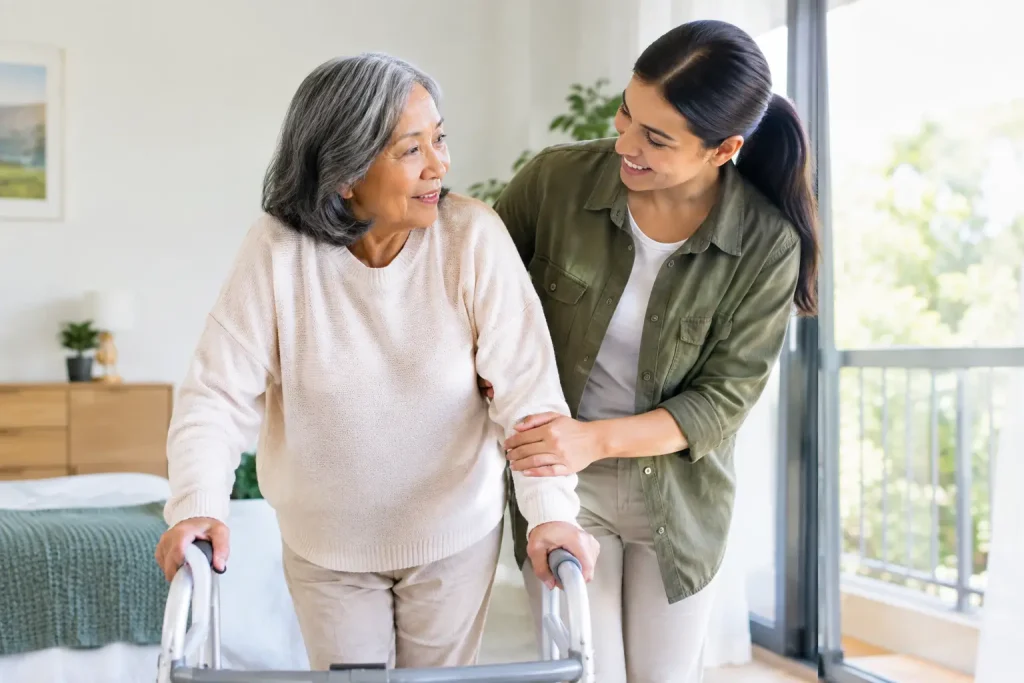
Double-handed care at home means two people are needed together for particular care tasks, as identified through an individual assessment. Often called two-carer support, it may involve assistance with transfers, repositioning or personal care. It does not automatically mean two carers are required throughout the day.
A transfer from bed to chair can look like a small part of someone’s routine. But when their mobility changes, the help that once felt manageable may become uncomfortable, unpredictable or unsafe.
For families, the question is not simply whether a relative needs “more care”. It is whether particular tasks can still be carried out safely by one person, and what arrangements would help the person remain comfortable and involved in life at home.
What does double-handed care mean in practice?
Double-handed care means both people are present and working together for the task identified in the care plan.
It is different from having two regular carers who take turns on a live-in rotation. In a double-handed arrangement, the additional support is needed at the same time.
For example, someone may enjoy meals, conversations and activities with support from one carer but need two people for certain transfers. Another person may require two-carer assistance at several points during the day.
The arrangement should reflect the individual’s needs rather than a general assumption about their age or diagnosis. The aim is to provide appropriate help without taking over activities they can still manage themselves.
When might two carers be needed?
Two-carer support may be considered for tasks such as:
- Moving between a bed, chair, wheelchair or commode.
- Repositioning in bed or providing personal care where turning or maintaining a position is difficult.
- Using moving-and-handling equipment where the assessment identifies a need for two people.
The person’s weight is only one consideration. Their balance, ability to support themselves, pain, fatigue and ability to participate in the movement can also affect the help required.
The home matters too. A cramped bedroom, unsuitable furniture or insufficient space for equipment can change how a task needs to be approached.
Two people being present does not, by itself, make an unsafe manoeuvre safe. Appropriate equipment, training and an agreed method remain important.
Who decides whether double-handed care is required?
The decision should follow a moving-and-handling assessment completed by someone with appropriate competence. Depending on the circumstances, this may involve the care provider, an occupational therapist, a physiotherapist or a specialist moving-and-handling adviser.
The assessment should explain what the person can do independently, which tasks require assistance and how that assistance will be provided. The findings should be recorded in the care plan and made available to those involved.
The person receiving care should be included in the discussion, with support to communicate their preferences and concerns.
Families can ask their care provider to explain the assessment. For advice about moving and handling at home, the NHS recommends asking for an occupational therapy assessment.
Does using a hoist always require two carers?
No. Using a hoist does not automatically mean two carers are required, but it should never be assumed that one person is sufficient either.
The number of people needed depends on the individual, the particular transfer, the equipment, the environment and the assessment. Relevant manufacturer’s instructions must also be followed.
The Health and Safety Executive’s guidance on moving-and-handling equipment explains that the care plan should specify the equipment and number of carers required.
Where the assessed plan requires two people, a carer should not attempt that task alone because someone is late, unavailable or confident they can manage.
Signs that the current arrangement needs reviewing
Changes can happen gradually. Getting out of bed may take longer, a person may become more anxious about being moved, or a relative may find themselves taking more of the person’s weight than before.
Repeated near-misses, pain during assistance or difficulty completing essential personal care are reasons to seek a review. So is a change in health that makes movements less predictable.
One difficult morning does not establish the right long-term arrangement, but it should not be dismissed. Describe what happened, when it occurred and how it differed from the person’s usual routine.
If a movement cannot be completed safely using the agreed approach, seek advice rather than improvising a lift. The NHS advises people who regularly help someone move to obtain appropriate training or guidance from a healthcare professional.
How double-handed care can work alongside live-in care
Live-in care can provide continuity with everyday routines, companionship and personal support. Where particular tasks require two people, an additional trained carer may attend at agreed times to work alongside the live-in carer.
For example, the assessment might identify a need for additional assistance during the morning routine and when settling for the evening. The arrangements must also account for any other tasks that need two people between those visits.
This is particularly important when someone needs help with toileting, repositioning or transfers at unpredictable times. A morning and evening visit would not cover a two-person task needed during the afternoon.
Before care begins, establish who will provide the additional support, when they will attend, how the carers will communicate and what happens if cover is unavailable. Do not assume a second carer is included in a standard live-in arrangement.
A live-in carer also needs planned breaks and suitable rest. Where two-person support is needed overnight, the care package must provide the appropriate staffing; one live-in carer cannot meet a two-person requirement alone.
Can a family member act as the second person?
In some arrangements, a family member may participate alongside a professional carer. This must be specifically assessed and agreed, rather than assumed because the relative lives in the home.
The family member needs to be willing and able to undertake the agreed role, with appropriate task-specific training and competence. Their own health, availability and comfort with the responsibility should be considered.
There must also be a plan for when they are unwell, away or no longer able to help. Nobody should feel pressured to take on moving-and-handling tasks simply to fill a gap in professional support.
Discuss this openly with the provider and the professional responsible for the moving-and-handling assessment.
Planning support after a hospital stay
If someone is returning home from hospital, the arrangements should reflect the home they are returning to, not simply repeat what happened on the ward.
Ask the discharge team to clarify the person’s current moving-and-handling needs, any recommended equipment and who is responsible for arranging the required support.
The proposed care package should be coordinated before discharge, including the availability of a second person wherever needed. Equipment and staffing arrangements should not be left for the family to work out after the person arrives home.
Our home from hospital care service explains how live-in support can be considered as part of planning a return home.
Protecting dignity when two people provide care
Needing additional assistance can feel like a significant change, particularly during washing, dressing or using the toilet. The person may worry about privacy or feel uncomfortable with another person in the room.
Good care should address those concerns through practical choices. Explain who will be involved, ask how the person prefers support to be offered, and protect their privacy throughout.
Carers should communicate with the person rather than talking over them. They should also support the person to do the parts of a task they can manage, instead of assuming that needing more physical help means losing control over the whole routine.
Preferences about personal care should be discussed and recorded, with reasonable efforts made to accommodate them safely.
Questions to ask before arranging two-carer support
Before agreeing the care package, ask:
- Which specific tasks require two people, and where is this recorded?
- Who will provide the additional support, including at night or outside planned visits?
- What equipment and training are needed, and who is responsible for arranging them?
- What happens if the second person is unavailable?
- What charges apply, and when will the arrangement be reviewed?
Clear answers help everyone understand their responsibilities before a difficult situation arises.
Frequently asked questions about double-handed care
Does double-handed care mean two carers must live in the home?
Not necessarily. Additional support may be needed only for particular tasks at agreed times. Where needs are frequent or unpredictable, a different staffing arrangement may be required. The assessment should establish what is workable and safe.
Is double-handed care always permanent?
No. Support should be reviewed when circumstances change. Recovery, changes in equipment or a different home arrangement may alter what is needed, while declining mobility may increase the help required. Do not reduce the agreed assistance without reassessment and an updated plan.
Does double-handed care cost twice as much?
There is no single pricing rule. Costs depend on the overall arrangement, including how often the additional person is needed and who provides that support. Ask for a written quote that distinguishes the live-in care fee from any additional visits or overnight arrangements.
Discuss your care needs with Live In Care Ltd
Live In Care Ltd is a family-owned, CQC-regulated live in care company providing fully managed care across England.
Our team assesses individual needs, agrees a care plan, matches a suitable carer and coordinates ongoing support. Where moving-and-handling needs are more complex, we will discuss whether a suitable live-in arrangement can be put in place and what additional support would need to be agreed.
Call 0800 772 3567 or contact Live In Care Ltd to discuss your circumstances and arrange a care assessment.
The purpose of double-handed care is not simply to add another pair of hands. It is to organise essential support around the person’s safety, dignity and choices, so that receiving more help does not mean losing their voice in everyday life.